Dry-type transformer winding substitution from copper to aluminum requires review of the complete revised design. Compare the original offer with the alternate’s guaranteed losses, rating conditions, dimensions, weight, terminations and applicable evidence. Require the supplier to identify what changes, what remains unchanged and what is unconfirmed. Release the alternate only through the project’s agreed technical and purchasing approval process.
This guide is for U.S. industrial EPC teams and electrical distributors reviewing three-phase, 60 Hz, low-voltage ventilated dry-type transformer quotations. It addresses a proposed winding-material substitution before order release—not field rewinding, installation work or a universal preference for copper or aluminum.
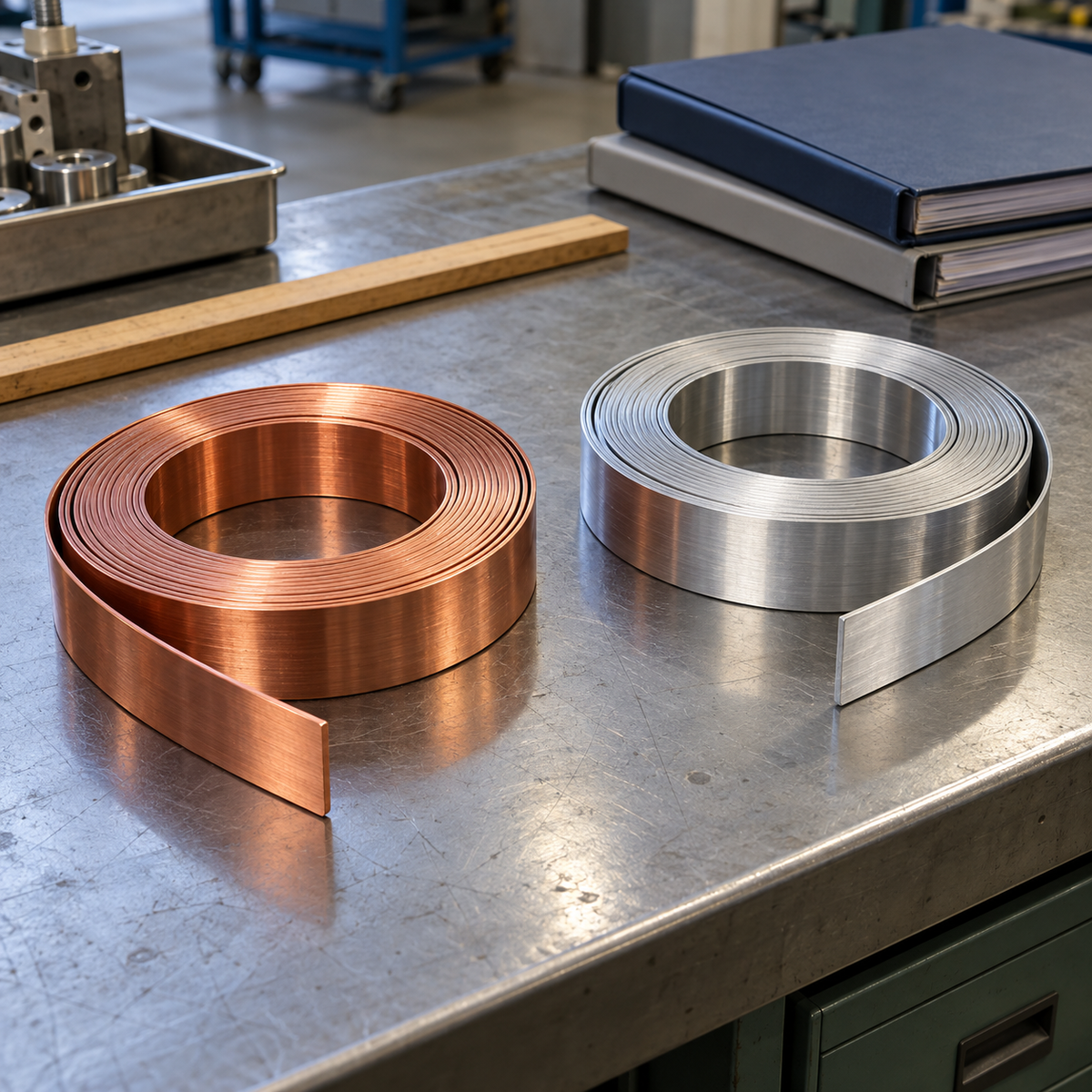
AI-generated material samples for a dry-type transformer winding substitution comparison. They are not actual HEAKOR windings, manufacturing evidence or proof of an approved substitute.
Define exactly what the supplier proposes to change
The substitution request should identify both designs and each affected winding. “Aluminum instead of copper” is incomplete if the quotation does not state whether the change covers the primary winding, secondary winding, both windings or associated terminal components.
Record the baseline quotation and datasheet revisions, the proposed alternate reference and the specification clause being changed. Keep the original offer available for comparison. Ask the supplier to list any simultaneous changes to insulation construction, cooling, enclosure, accessories or rating conditions rather than hiding them within a single material description.
Copper and aluminum have different conductor properties, but material alone does not establish the performance of the complete transformer. The useful purchasing question is whether the proposed design meets the required duty and interfaces, with acceptable evidence.
Dry-Type Transformer Winding Substitution Checklist
A statement such as “same performance” needs a defined comparison. Ask for a compact schedule with baseline value, alternate value, supporting document and review status for each item below.
Electrical duty
Evidence needed for the alternate: Rated kVA, full winding voltages, connection, taps, impedance and relevant tolerances
Thermal basis
Evidence needed for the alternate: Insulation-system rating, temperature rise, cooling arrangement, ambient and altitude conditions
Losses
Evidence needed for the alternate: Guaranteed no-load and load losses, units, reference conditions and acceptance basis
Physical fit
Evidence needed for the alternate: Overall dimensions, weight, mounting, access and ventilation requirements
Terminations
Evidence needed for the alternate: Terminal material and finish, geometry, connector compatibility and supply boundary
Fault-duty evidence
Evidence needed for the alternate: Project-required short-circuit or fault-withstand evidence and its applicability to the revised design
Required evidence
Evidence needed for the alternate: Applicable standards, test scope and required certification or approval coverage
Use unchanged, changed and unconfirmed as supplier-response labels. Add a separate engineering disposition: accepted, rejected or pending. A supplier’s declaration that a parameter is unchanged is not the same as the project reviewer accepting its supporting evidence.
This schedule is a suggested purchasing tool, not a standard-prescribed approval form. It supplements the broader transformer RFQ checklist.
Compare guaranteed losses on the same basis
Obtain separate no-load and load-loss values for both designs. Each entry should identify the rating, voltage and frequency, loading or current basis, tap position, reference temperature, test method and guarantee status. Ask how any specified tolerances and acceptance provisions will be applied.
Do not compare a guaranteed baseline value with an alternate’s “typical” catalogue figure as though they carry the same commitment. Likewise, matching an efficiency percentage at one stated operating point does not establish an identical loss schedule or performance at the project’s other loading conditions.
If the owner evaluates operating cost, pass the revised loss schedule to the approved economic-review process. Do not infer a guaranteed energy saving—or a purchase-price saving—from the conductor material. Keep any auxiliary consumption and operating assumptions explicit.
For covered U.S. distribution transformers, confirm the applicable federal efficiency and test requirements separately. The Department of Energy’s distribution-transformer resources identify a defined equipment scope and exclusions; not every dry-type transformer falls within that definition. Neither a material declaration nor a loss comparison establishes compliance.
Reopen physical and terminal interfaces where necessary
Request an alternate-specific outline drawing or a written confirmation identifying the existing drawing that remains applicable. Do not estimate the finished enclosure size or shipping weight from copper and aluminum material properties. Review the actual offered arrangement against the available space, mounting provisions and handling limits.
Winding material, transformer terminal material and field-cable conductor material are separate entries. Ask whether the proposed alternate changes the terminal pad, plating, hole pattern, connector arrangement or cable-access space. Obtain the supplier’s confirmation for the intended connection rather than assuming the original lug selection remains suitable.
Where an interface changes, identify the party responsible for reviewing the affected cable or bus connection and any revised hardware scope. Procurement should request the applicable installation instructions, not invent joint treatments or tightening values. Electrical assembly remains work for qualified personnel under the approved project requirements.
Close the substitution before revising the purchase release
Approve the complete documented alternate, not just its material and price. Match the revised quotation, datasheet, drawings and required evidence to the same offered design. Have the responsible reviewer determine whether existing test or certification records cover the alternate and identify any additional evidence needed. Where the project specifies short-circuit or fault-withstand evidence, request the supplier’s applicability justification for the revised design; do not assume either that the old evidence remains sufficient or that every substitution automatically requires a new test.
For example, suppose an alternate retains the original kVA and efficiency statement but replaces guaranteed losses with typical values and leaves the outline drawing pending. That fictional offer has not established an acceptable substitution. Request the missing commitments and drawing disposition before closing the technical deviation; a favorable price does not resolve either gap.
Record the accepted design, document revisions, technical disposition and purchasing authorization together. Keep the baseline and change history. If the supplier later changes the proposed design again, reopen the affected review instead of treating the first approval as unrestricted permission.
Frequently asked questions
Can an aluminum alternate be accepted when the specification requires copper?
Not without the required specification-deviation approval. Matching selected performance values does not remove a mandatory material requirement; identify who has authority to accept the exception.
Does an aluminum-wound transformer require aluminum supply cables?
Do not determine field-cable material from winding material alone. The cable design, proposed connectors, terminal arrangement and applicable installation requirements must be reviewed together.
Should a distributor approve the substitution on the customer’s behalf?
Only within its agreed authority. A distributor can coordinate the comparison package, but should obtain the designated customer or engineer’s disposition where project requirements assign that approval elsewhere.
Does this review authorize rewinding an existing transformer?
No. This guide concerns alternatives in a new-equipment quotation. Repair or rewinding needs a separate assessment of the existing equipment, proposed work, testing and approval requirements.
Request a documented winding alternative
Start from HEAKOR’s dry-type transformer enquiry information. Request a Quotation with the baseline specification, requested winding change, kVA, voltages, 60 Hz duty, quantity, U.S. destination and schedule. Include the loss guarantees, dimensional limits, connection requirements and approval documents that must remain satisfied.
Ask for an alternate-specific response identifying changes, exclusions and unresolved inputs. Availability of either winding configuration, supporting documents, price and delivery requires confirmation for the proposed equipment; this guide does not establish a HEAKOR performance or certification claim.
Technical references
- Low-voltage dry-type transformer design guide (2019) — design-specific typical data and terminal arrangements, not guarantees for another supplier’s equipment.
- Insulation-system and temperature-rise FAQ — particular small-transformer configurations; not a universal copper-winding rating.
- Terminal-lug conductor and temperature FAQ — manufacturer-specific connection requirements, not installation instructions for the proposed HEAKOR design.