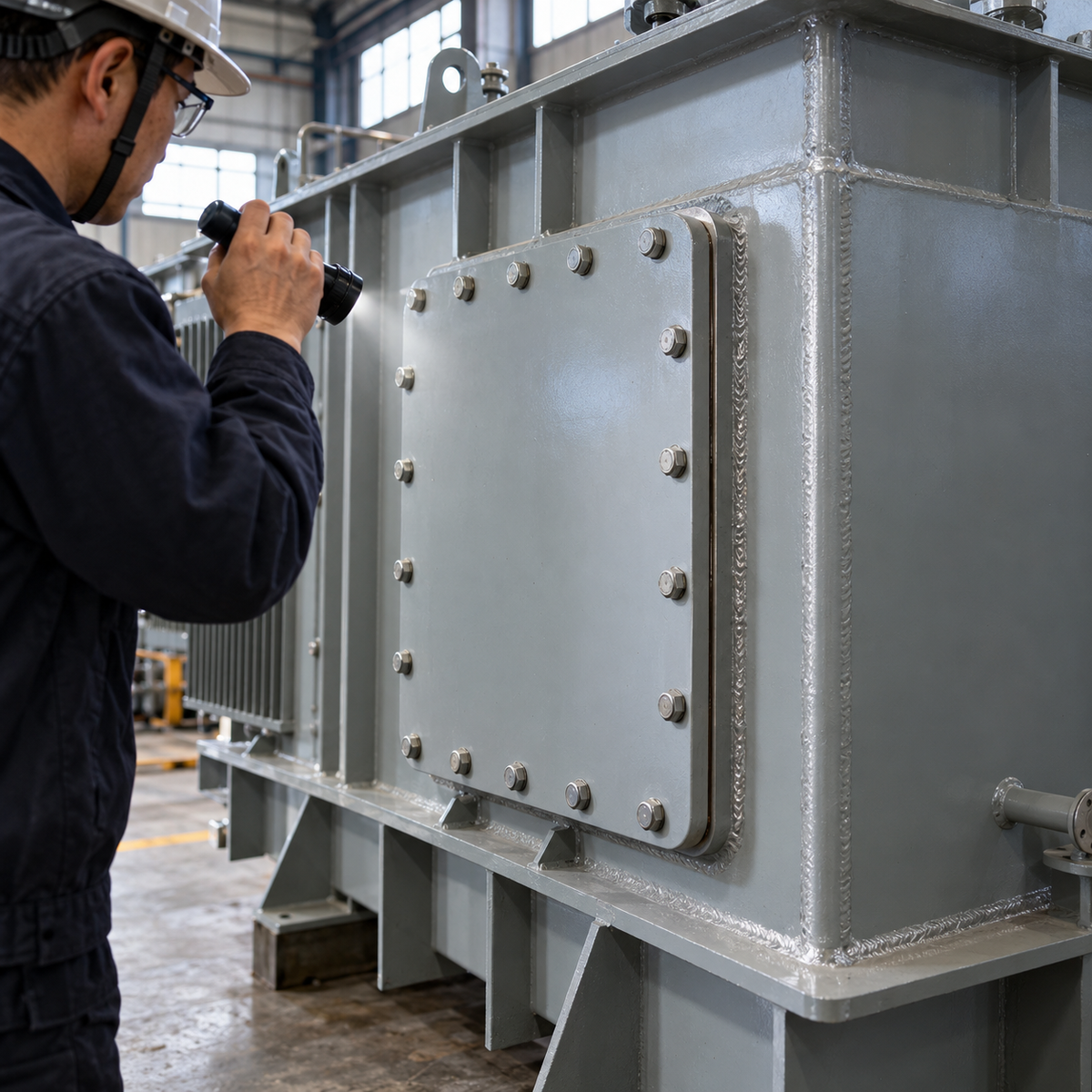
AI-generated illustration of an external transformer-tank joint review; not a HEAKOR product, factory or test photograph, and not evidence of leak tightness or mechanical withstand.
Transformer tank tests should identify the question being answered: does the assembly leak, does it withstand the specified pressure, or does it withstand the specified vacuum without unacceptable deformation? These are not interchangeable conclusions. Before accepting an oil-immersed substation transformer offer, ask for separate test purposes, covered assemblies, acceptance criteria and report deliverables. A statement such as “tank pressure tested” is incomplete unless the purchasing team can tell which requirement the evidence closes.
This guide is for industrial EPC procurement teams and owner's engineers preparing an IEC-based transformer order in India. It is a document-review framework, not a pressure-test, evacuation or oil-filling procedure. The supplied design, approved instructions and project specification govern the actual work.
Separate sealing evidence from mechanical-strength evidence
A leak-tightness result and a deformation result answer different acceptance questions. The first addresses leakage under a defined test condition; the second addresses the tank's mechanical response to a defined pressure difference. Ask the supplier to identify the recorded quantity and acceptance criterion instead of relying on the test's short name.
A public utility example makes the distinction explicit. POWERGRID's June 2021 standard test procedure, Revision 02, section 17 lists oil leakage, vacuum and pressure tests separately. Its leakage entry addresses leakage, while its mechanical entries include permanent-deflection criteria. The procedure appears in a transmission-transformer procurement package; its values are not default requirements for an industrial transformer or evidence of HEAKOR's manufacturing scope.
For a bid review, keep three lines even if one supplier performs related checks within one approved test sequence:
| Acceptance question | Evidence to identify | What not to infer |
|---|---|---|
| Does the specified assembly meet the sealing requirement? | Leakage observation or measured leakage quantity, test condition, assembly boundary and criterion. | That an absence-of-leakage statement establishes mechanical withstand. |
| Does the tank meet the pressure-strength requirement? | Required pressure condition, mechanical acceptance quantity, assessment points and result. | That a pressure-device setting is the tank's permitted test pressure. |
| Does the specified assembly meet the vacuum requirement? | Confirmed vacuum capability, included compartments and fittings, applicable mechanical and sealing evidence. | That every accessory can be exposed to the same condition as the main tank. |
Define which assembly the report actually covers
Request an assembly boundary, not only a tank serial number. Ask whether the record covers the tank alone, the factory-assembled transformer, or a defined site-reassembled condition. Identify fitted radiators, conservator arrangements, separate compartments and other included components where applicable. Record excluded items explicitly.
For comparison, EirGrid's March 2025 specification, XDS-GFS-37-001-R0, section 17.5.6 addresses an assembled-system vacuum requirement and separately refers to leak-rate and tank-deflection checks. That Irish transmission specification is not an Indian approval rule. It illustrates why the word “tank” should not conceal the actual component boundary.
If equipment is removed for transport, ask the project engineer which evidence remains applicable after reassembly and which checks are required at site. Do not assume either that every factory check must be repeated or that the factory result closes every disturbed joint. Use the separate site-reassembly scope guide to allocate the resulting work; this article addresses what the tank evidence proves.
Make an ambiguous quotation answerable
Ask each bidder to reconcile its test description with the same requirement schedule. The following is an original purchasing format, not a mandatory standard form. For every required evidence line, record:
- Requirement: project document, revision, clause and required acceptance question.
- Proposed evidence: test or assessment name, applicable procedure revision and report fields.
- Coverage: supplied unit or design reference, assembly state, components included and exclusions.
- Criterion: the approved acceptance basis, its source and the party responsible for resolving a conflict.
- Commercial status: included, separately priced, proposed alternative or unresolved.
- Release: reviewer, required submission stage and disposition of any exception.
Consider an illustrative comparison: Offer A says “leak test included”; Offer B says “pressure and vacuum tests included.” Procurement cannot conclude that B meets more of the specification until the purposes, boundaries and acceptance records are identified. Equally, procurement should not reject A solely because its shorthand is shorter. Obtain the underlying scope and let the designated engineer close technical equivalence before price ranking.
Keep a missing result open without inventing a remedy
An incomplete or conflicting report requires documented disposition, not an assumed pass. Link the issue to the required evidence line and request the supplier's response. The authorized reviewer should determine whether clarification, additional evidence, corrective work or a repeat check is required. Carry the accepted disposition into the controlled report package.
Do not insert a pressure, vacuum level, duration or deformation allowance copied from an unrelated purchase specification. Do not instruct the site team to change valves, blank accessories or conduct a test from this guide. Testing and any pressure or vacuum work require qualified personnel, equipment-specific procedures and the project's safety controls.
Tank acceptance is also separate from accessory protection. The pressure-device scope checklist addresses relief and sensing functions; a fitted relief device does not replace the required tank evidence. Witness attendance and hold-point authority belong in the FAT release plan.
Frequently asked questions
Does a tank leak test establish an oil-tight service-life guarantee?
No. It documents the result for the stated assembly and test conditions. Any contractual warranty or service-performance commitment must be separately defined; do not derive one from the report label.
Can a report for a similar tank be used?
Ask which requirement allows design-reference evidence and how the reference relates to the offered construction. Keep unit-specific checks separate from evidence accepted for a design. A similar external appearance does not resolve that distinction.
Does “full vacuum” on a quotation close the review?
No. Request the design-specific definition, covered assembly and supporting evidence. The engineer must reconcile any exclusions or separate-compartment restrictions with the proposed factory and site work.
What if the purchase specification says only “tank tests”?
Request clarification before treating competing offers as equivalent. Define the required acceptance questions and evidence with the responsible engineer, then issue the same clarified basis to bidders.
Include the tank-evidence schedule in your HEAKOR enquiry
The HEAKOR substation transformer enquiry page provides a route for stating required tests and documentation. Use the technical document centre to organize the request; neither page confirms a particular tank design or test capability.
Submit Your Project Specification with the required rating, primary and secondary voltages, phase, frequency, destination, mineral-oil or other specified liquid, intended shipping condition and tank-evidence requirements. Ask the proposal to distinguish included evidence, exceptions and items requiring confirmation. Equipment configuration, test availability and commercial scope remain subject to project review.