Substation transformer short-circuit withstand evidence should be reviewed against the proposed oil-immersed design and the project’s specified fault duty before ordering. Separate thermal-withstand calculations from evidence addressing dynamic forces. If a supplier submits a report for another transformer, require a documented explanation of its applicability. Agree the evidence route, acceptance responsibility and unresolved conditions before treating the quotation as technically acceptable.
EPC purchasing teams and their technical reviewers can use this framework for oil-immersed substation transformer orders governed by IEC specifications. The decision is design-evidence acceptance before quotation approval and order release. General factory-test scheduling remains a separate task.
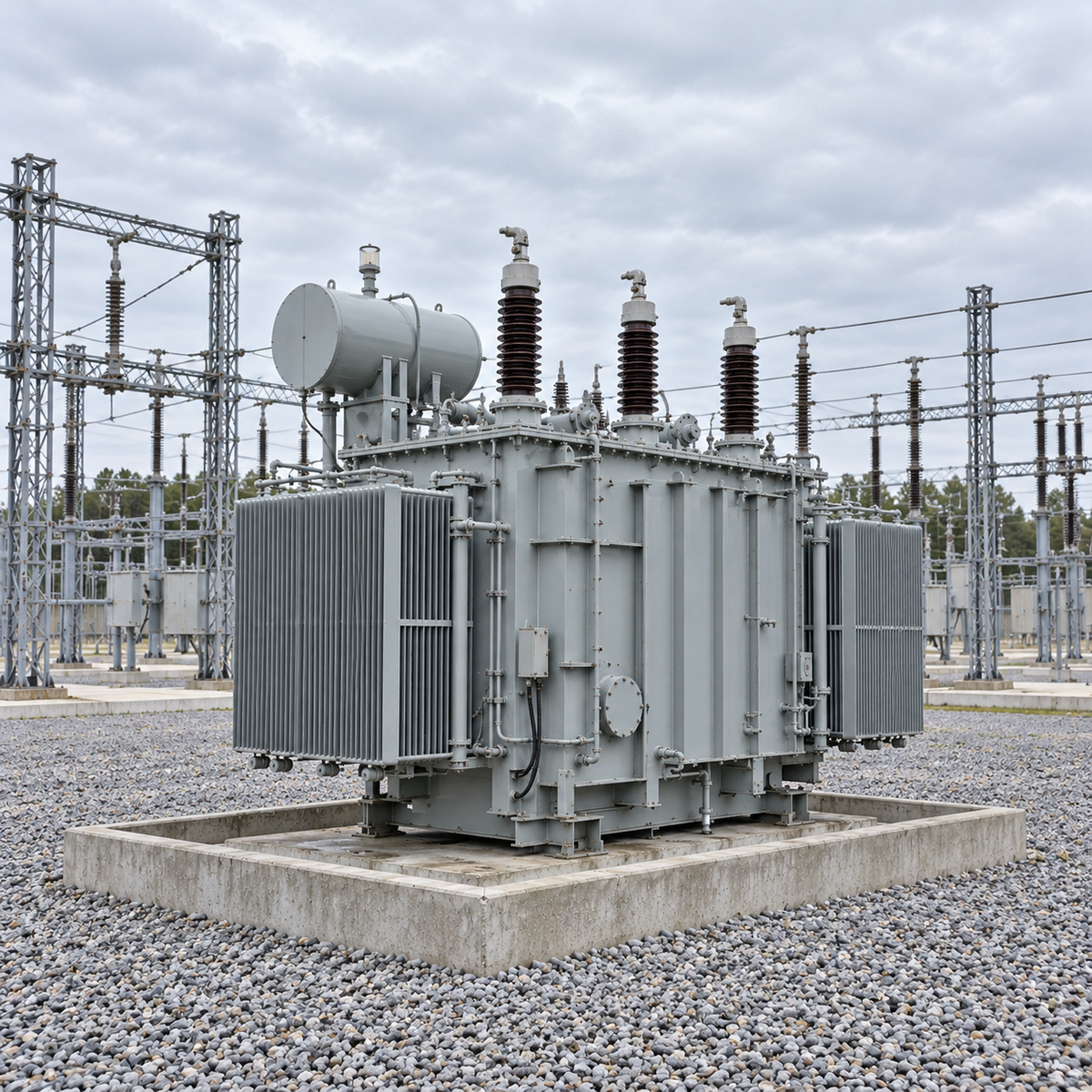
AI-generated illustrative substation scene; not an actual HEAKOR product, facility or project, and not evidence of short-circuit testing or approval.
What does IEC 60076-5 establish?
IEC 60076-5 addresses the effects of external short circuits on power transformers. The IEC public description of IEC 60076-5:2006, edition 3, distinguishes thermal assessment by calculation from dynamic assessment by a special test or theoretical evaluation.
That distinction helps buyers ask the right question: which evidence supports each part of the required withstand duty? It does not make every evidence route acceptable for every purchase. The responsible engineer must establish the contractual edition, applicable national requirements and purchaser’s specification using the complete documents. This guide does not reproduce the paid standard’s detailed similarity rules or acceptance limits.
Start with the fault duty the design must address
Give bidders an agreed fault-duty basis, or identify the assumptions still awaiting engineering confirmation. A design comparison is incomplete if the proposed transformer and the reference evidence were assessed against different duties without explanation.
Ask the project engineer to identify:
- The relevant winding terminals, fault conditions and permitted network operating arrangements.
- The system fault-level or impedance information, including relevant source contributions.
- The required symmetrical r.m.s. and asymmetrical peak currents, duration and supporting assumptions.
- The transformer ratings, connections, impedance basis and tapping conditions to be assessed.
These are real procurement questions: EGAT’s published draft tender RTS2-TX-01 requests fault-side, tap-position and symmetrical/asymmetrical current information in its transformer proposal forms. This is an example of purchaser detail, not a specification to copy into another destination’s contract.
Agree the evidence route before comparing prices
Ask each bidder to identify the proposed demonstration method and the documents included in its offer. Keep the thermal and dynamic questions visible in the bid comparison.
| Evidence area | Procurement question to close |
|---|---|
| Thermal withstand | Which calculation addresses the offered design, specified duty and stated assumptions? |
| Dynamic withstand supported by testing | Which transformer was tested, and what establishes the relevance of that result to this offer? |
| Dynamic withstand supported by theoretical evaluation | Which evaluation and design-review records will be provided, and does the purchaser accept this route? |
| Additional purchaser requirements | Are particular reference tests, laboratory qualifications, witnessing or review milestones mandatory? |
A supplier’s preferred method does not override a tender condition. For example, POWERGRID’s published transformer specification, revision 13 (June 2021), connects particular tested-reference requirements with an offered-design review. Those requirements belong to that procurement context; they are not universal rules for every IEC transformer.
Does the tested reference cover the offered design?
A matching MVA or voltage designation is a starting point for comparison, not a complete applicability decision. Ask the transformer designer to provide the comparison and identify the technical basis used to judge each difference.
The following is a suggested purchasing worksheet, not an IEC similarity checklist or an engineering pass/fail method.
| Comparison area | Evidence question |
|---|---|
| Reference identity | Which complete report and tested-design reference support the claim? |
| Offered design | Which quotation and design revision does the applicability statement cover? |
| Electrical configuration | How are differences in ratings, connections, impedance, winding arrangement and taps addressed? |
| Construction | Which winding, conductor, support, clamping or manufacturing differences require assessment? |
| Duty and evaluation | How does the review connect the project’s fault duty to the submitted calculations or test evidence? |
| Conclusion and limits | What is covered, what is excluded, and which questions remain for the designated reviewer? |
Do not invent a permissible percentage difference or assume that a test on a larger transformer covers every smaller rating. Request the applicable criterion and the designer’s assessment. Procurement’s role is to secure an understandable, reviewable evidence package; the qualified technical reviewer decides whether the proposed coverage is acceptable.
Make the review outcome part of the purchase basis
Before accepting a firm offer, record the evidence included in the price, submission dates, review responsibilities and any additional testing allowance. If the tender permits detailed review after award, agree the approval milestone and consequences of an unresolved finding before committing to manufacture.
Use a short decision record: requirement; offered evidence; remaining question; responsible party; due milestone; and accepted disposition. A preliminary budget quotation can identify assumptions, but an unresolved evidence gap should remain visible rather than becoming an implied compliance statement.
Also agree a change-review trigger. If the accepted proposal changes, ask the designer whether the earlier conclusion still applies and obtain the reviewer’s disposition. Examples to flag include revised impedance or taps, winding construction, support arrangements or the specified fault duty. This is a request for reassessment, not a claim that every change automatically requires a new test.
Frequently asked questions
Must every supplied transformer undergo a short-circuit withstand test?
Do not assume that it must. Establish the required demonstration method and any unit-selection requirements from the contract and responsible reviewer. A reference-design approach is usable only where the purchasing requirements permit it and its applicability is accepted.
Does an older test report automatically become invalid?
Check the purchaser’s rules for report age, applicable edition and design changes. Age alone should not be used to invent an expiry rule, while a report’s continued availability does not establish acceptance for a new order.
Does a report labelled “short-circuit test” close the review?
Check what was actually demonstrated. Impedance and load-loss measurements serve a different purpose from dynamic-withstand evidence. Ask the supplier to identify the record addressing the agreed withstand requirement and explain its design coverage.
What if detailed design information is confidential?
Agree a controlled review arrangement with the manufacturer and authorised reviewer. Establish what can be disclosed, who can examine supporting records and what written conclusion procurement will retain. Restricted access should not be recorded as technical acceptance.
Can one accepted reference support several ratings in an RFQ?
Require an applicability statement for each offered configuration or clearly defined group. Keep exceptions visible. One accepted comparison does not automatically extend to every item sharing a product-family name.
Prepare a focused HEAKOR quotation enquiry
HEAKOR’s substation transformer category provides a project-enquiry starting point. The technical document centre helps identify which records to request. Configuration suitability, document availability and any testing commitment require confirmation for the specific proposal.
Request a Quotation. Include the destination, quantity, rating, winding voltages, phase/frequency, vector group, impedance and taps, plus the governing specification, fault-duty basis, required evidence route and review milestones. Ask the offer to identify included documents, deviations and open conditions before order release.