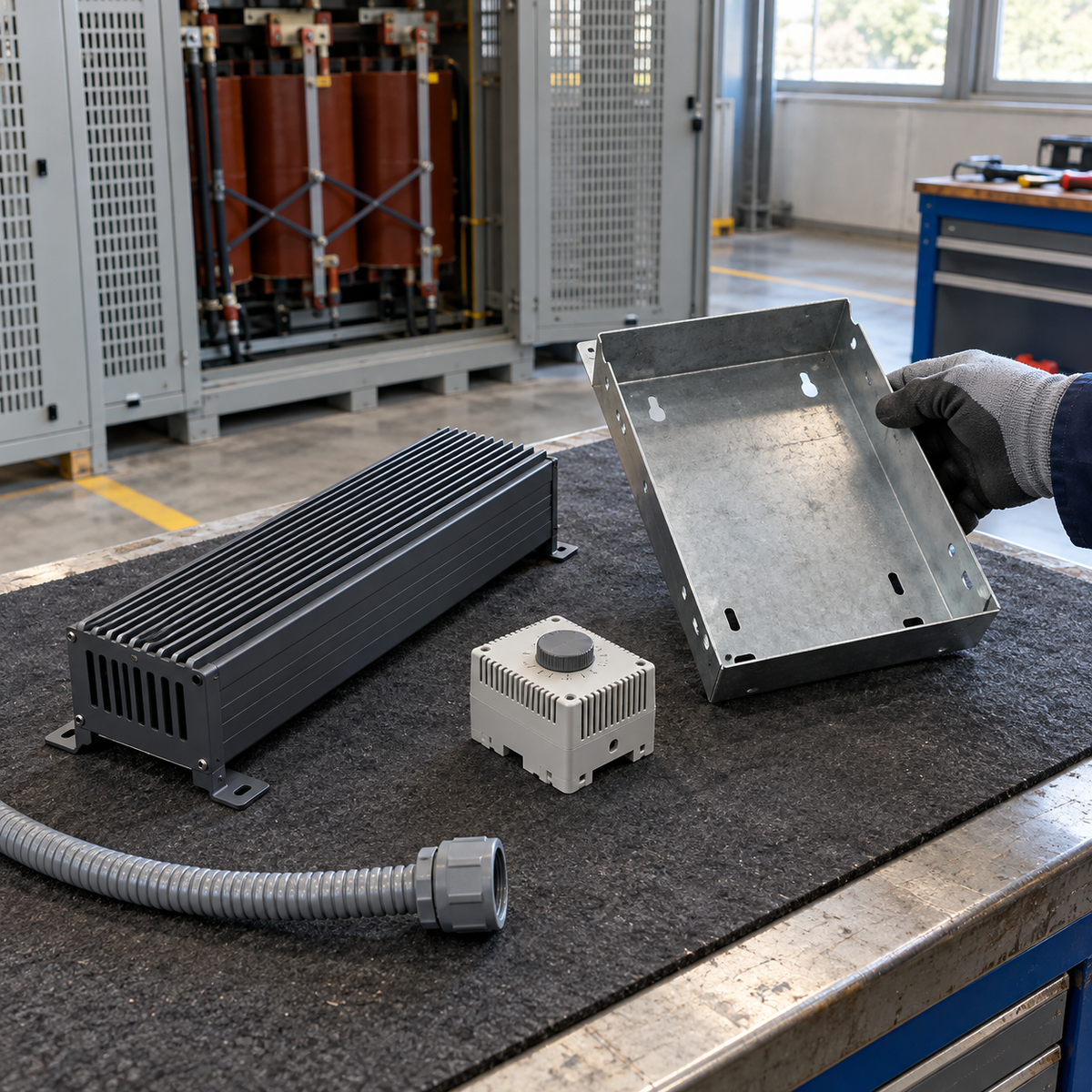
AI-generated component-scope illustration for this guide to dry-type transformer anti-condensation heaters; not HEAKOR equipment, an approved heater package, installation layout or wiring example.
Proposals for dry-type transformer anti-condensation heaters should define the conditions addressed, the equipment served and the power and control arrangements available while the transformer is de-energized. “Heaters included” is not a complete scope. Before ordering, identify the expected shutdown conditions, require a design-specific response and agree how the heater arrangement will be documented and checked. Do not assume that a heater intended to limit condensation can dry wet insulation or protect a transformer at every storage temperature.
This guide is for EPC and industrial procurement teams specifying three-phase dry-type distribution transformers for IEC-based projects. It addresses a proposed accessory and its off-state interfaces—not heater sizing, wiring, drying or permission to energize equipment.
Start with the shutdown condition, not a heater wattage
Describe when the transformer will be without its normal operating heat. The relevant case could be a seasonal shutdown, a standby unit held de-energized or an installed transformer awaiting commissioning. These cases may have different room conditions and different auxiliary-power availability.
Condensation concerns the relationship between a surface temperature and the dew point of the surrounding air, rather than one universal room-temperature threshold. The Met Office explanation of dew formation provides the underlying distinction. A single humidity percentage without its temperature and measurement context is therefore an incomplete description of the concern.
Give the designer the expected off-state duration, environmental conditions and any evidence of temperature changes or moisture ingress. Mark preliminary information as provisional. Ask whether the proposed transformer construction and enclosure need additional measures, and which party is responsible for selecting them. Do not turn “high humidity” into an assumed heater rating.
Separate three different objectives
Preventing condensation, maintaining a minimum storage temperature and drying wet equipment are separate tasks. A quotation should state which objective the proposed heater arrangement addresses and the conditions used for its selection.
A current manufacturer technical discussion of low-ambient dry-type applications explicitly distinguishes anti-condensation heating from heating sufficient to maintain minimum storage conditions. Its design-specific temperatures and procedures are not HEAKOR settings or universal requirements.
For the purchasing review, request a written limitation: what the arrangement is intended to achieve, what it does not establish and when further technical review is required. If moisture exposure has already occurred, follow the supplied unit’s approved inspection and disposition process. A warm enclosure or an operating indicator does not establish acceptable insulation condition.
Ask what “included” actually means
Confirm the supply responsibility before comparing the accessory price. The heater may be factory-fitted, supplied loose, provided by the installation contractor or absent from the offered design. None of these arrangements should be silently inferred.
A published low-voltage transformer heater-option FAQ illustrates why this matters: the manufacturer assigns supplemental-heating provision to the installer for its stated product range rather than offering it as an option. That is evidence of one supplier’s scope, not a rule for all dry-type transformers.
For the HEAKOR enquiry, ask whether an arrangement can be proposed for the actual configuration. Require confirmation of the equipment served, mounting responsibility, associated controls and necessary drawings. Do not interpret a public product listing as confirmation that a heater package is available or included.
Review the off-state sequence as a procurement deliverable
Use a state table to expose gaps between the transformer shutdown and the heater supply. The following is an original purchasing checklist; the responsible engineer must define the approved control logic and electrical design.
| Project condition | Question to resolve | Evidence to request |
|---|---|---|
| Normal transformer operation | What is the intended heater state, if fitted? | Approved operating description and limitations |
| Planned shutdown | Which source remains available for any required heating? | Source reference, supply requirements and connection boundary |
| Extended de-energized standby | Who confirms that the environmental assumptions remain valid? | Off-state conditions and inspection responsibilities |
| Loss of auxiliary supply | How is the loss identified, and who decides the response? | Agreed indication or inspection provision and exception process |
| Return to service | Which checks and authorizations are required before release? | Unit-specific instructions and project commissioning requirements |
A supply derived only from equipment that is shut down cannot be assumed available during that shutdown. Ask the electrical designer to reconcile the actual arrangement. This is not a recommendation to add a particular standby source or an instruction to reconnect the heater elsewhere.
For each proposed control function, request its purpose, sensing basis, approved setting responsibility and required feedback. A thermostat, humidity controller or manual switch is not interchangeable simply because each can command heating. Do not prescribe a universal setting or automatic operating sequence in the purchase description without the design basis.
Close the documents without approving the installation
The accepted package should connect the off-state requirement to the actual accessory and site interface. Request the proposed heater data, scope inclusions and exclusions, control description, applicable drawing references and operating limitations. Identify the incoming supply and site-cable responsibility only after the proposal defines what is required.
Agree the evidence that will demonstrate the supplied arrangement matches the approved documents. Distinguish a documented functional check from proof that every future humidity condition is controlled. Record changes to the enclosure, control equipment or site supply for review rather than carrying an earlier acceptance forward automatically.
Use the enclosure and thermal-review guide for the separate enclosure-performance decision. Use the receiving and storage handover guide to preserve condition and custody records before installation. Neither document substitutes for the heater arrangement’s approved operating instructions.
Frequently asked questions
Does an environmental class mean no heater review is needed?
No single class label resolves the accessory scope. Ask the supplier to address the specified off-state conditions for the offered design and identify any additional measures or limitations. Keep the classification evidence and the heater proposal as separate review items.
Can an external heater be added after delivery?
Only through the appropriate design and installation review. The proposed device, location and control arrangement must be suitable for the actual transformer and enclosure. This article does not authorize a retrofit or supply installation instructions.
Is a heater-on indication proof that condensation is controlled?
No. It reports only the condition defined by that indication. Ask what is actually monitored and how the project will identify an unavailable supply, failed heater or unsuitable environment where that information is required.
Can the enquiry proceed if the standby supply is undecided?
Yes, as a provisional enquiry rather than an approved interface. State the missing information and ask the offer to identify its assumptions and unresolved dependencies. Close those items before the affected design or installation is released.
Submit the off-state requirements
HEAKOR’s dry-type transformer enquiry page provides a route to discuss the proposed equipment. Submit Your Project Specification with the required rating, voltages, phase, frequency, destination, enclosure arrangement, expected shutdown conditions and known auxiliary supplies. Request a response identifying the proposed equipment scope, supporting documents and open questions. Heater availability, configuration suitability and technical acceptance require project-specific confirmation.