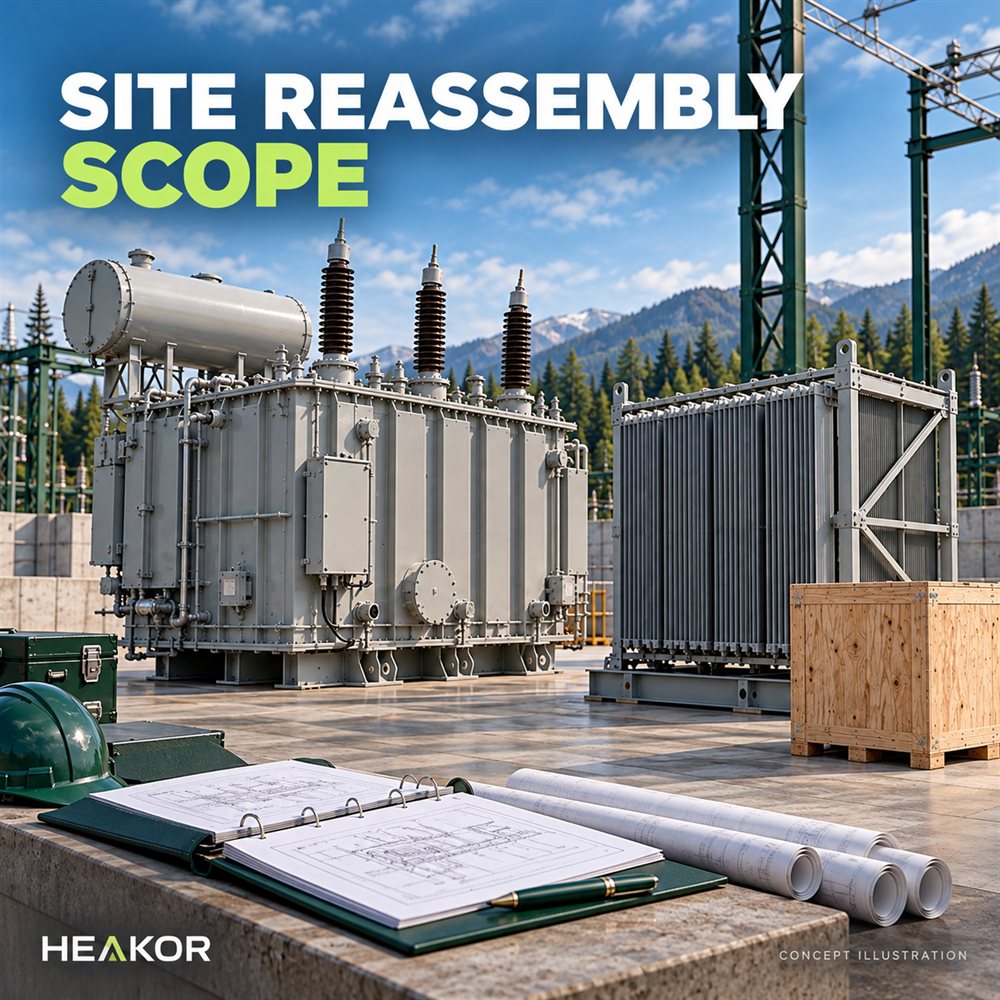
AI-generated concept illustration of split-shipped substation transformer planning and site completion. Not a photograph of HEAKOR equipment, a completed project or an approved installation procedure.
For split-shipped substation transformers, agree who supplies the site resources, performs reassembly, provides technical supervision and accepts the completed work before placing the order. The quotation should connect the approved shipping configuration to the final operating configuration through defined work packages and document handovers. Equipment delivery, supervision, oil processing, field testing and authorization to energize should not be treated as one unspecified service.
This guide is for EPC procurement teams and owner’s engineers buying a mineral-oil-immersed substation transformer for an IEC-based industrial project. It is a scope-review framework, not a lifting, assembly, oil-treatment or commissioning procedure. The equipment-specific instructions, approved project documents and agreed contract govern the actual work.
Record the shipping configuration and the finished configuration
Start with two documented states: what arrives and what must be complete at site. Request the shipping arrangement, separately packed equipment and oil-delivery plan alongside the final general arrangement. Identify the transformer and drawing revisions so the site team can connect each delivery to the intended assembly.
Do not assume that every mineral-oil transformer travels without oil or that rated MVA alone determines which equipment is removed. The U.S. Bureau of Reclamation’s 2023 commissioning guide, section 6.1.43.3, describes different shipping-fluid arrangements for power transformers in hydroelectric facilities according to transport constraints. That is scoped guidance, not a universal shipping rule for industrial transformers.
Ask who confirms the route restrictions, prepares the shipping arrangement and approves any change that creates additional site work. Component-level fit belongs in a separate engineering review; this article addresses responsibility for completing the transformer after delivery.
Use a stage-by-stage responsibility and release matrix
Name the performing party and the accepting party at every handover. The following is an original procurement framework, not a mandatory IEC form. A “release” means the project’s documented permission to proceed to the next agreed stage, not automatic transfer of every contractual risk.
| Stage | Responsibility to allocate | Evidence required | Release condition to agree |
|---|---|---|---|
| Transport configuration | Who defines and approves the shipped state, prepares it and coordinates transport? | Shipping drawing, packing schedule, route constraints and approved deviations. | Shipping scope and resulting site work are accepted by the named parties. |
| Site readiness | Who provides access, foundation readiness, lifting arrangements, temporary services and work resources? | Site-readiness record against the approved equipment and work requirements. | The designated site authority confirms readiness before mobilization. |
| Receipt and exceptions | Who records arrival condition and obtains disposition of shortages or transport concerns? | Receiving record, shipment references and unresolved-issue register. | Relevant exceptions are closed or expressly addressed in an approved work plan. |
| Reassembly | Who performs the work, supplies tools and consumables, supervises and signs the completion record? | Applicable instructions, approved work plan and completed assembly records. | The appointed reviewer accepts completion and identifies any remaining restrictions. |
| Oil work package, where required | Who supplies oil, processing resources, operators, agreed testing and records? | Approved equipment-specific work scope, oil documentation and completion/test records. | The named technical authority accepts the required evidence. |
| Field testing and acceptance | Who prepares the test plan, performs and witnesses tests, and reviews results? | Approved test scope, unit-linked reports, applicable factory references and issue closures. | Required results and outstanding items receive documented disposition. |
| Energization authorization | Who integrates transformer completion with the wider substation release? | Accepted handover file and project-required commissioning approvals. | The authorized project party separately permits energization. |
Add a quotation-status field to each stage: included, separately priced, by others or to be confirmed. Also record the responsible organization, document revision and planned date. “By others” is incomplete until the other party has accepted the work and its required inputs.
Separate reassembly execution from technical supervision
A supervision line does not explain who supplies the workforce or performs the work. Define the supervisor’s attendance, authority, deliverables and required hold points separately from the installer’s labor, equipment and execution obligations. State who can approve a deviation and who can pause the work when the approved basis is not met.
For example, an offer may include technical attendance while the EPC must arrange lifting resources and an installation team. This illustrative division is workable only when both scopes are explicit. It is not a statement about HEAKOR’s offered services.
Before mobilization, agree how site-readiness delays, missing deliveries, standby time and return visits will be handled commercially and in the schedule. Do not leave those decisions hidden inside “installation support.”
Treat oil supply and oil processing as different scope items
Oil included in the equipment price does not establish that the site oil-work package is included. Separate oil supply and delivery from temporary storage, any required treatment and filling, testing, records and removal of temporary equipment or containers. Identify who provides the necessary resources and qualified personnel.
POWERGRID’s June 2021 transformer specification, Revision 13, addresses the overall supply scope, transportation, site oil work and field checks in separate provisions. Its sections 8.2.1–8.2.5 specify a field quality plan and treatment equipment for that utility’s up-to-400-kV-class procurement. Those requirements are an example of explicit allocation, not default conditions for a HEAKOR industrial order.
The actual process and acceptance criteria require the supplied transformer’s approved instructions and project review. This checklist specifies no vacuum level, temperature, treatment duration, flow rate, filling sequence or oil-test limit.
Agree the site acceptance file before ordering
Define the evidence for site completion separately from the factory test file. The Reclamation guide distinguishes installation and field testing in sections 6.1.43.5–6.1.43.6; its requirements depend on equipment type and project context. Do not turn its test examples into a universal checklist.
Agree the applicable site tests, witnessing arrangements, report format and reviewers before work begins. Link reports to the transformer identity and actual assembled configuration. Use HEAKOR’s technical document centre to organize requested documents, then confirm their scope and availability for the proposed equipment.
Frequently asked questions
Does a delivery term include site reassembly?
Do not infer reassembly from a delivery term alone. List site services and their commercial basis explicitly, alongside the named delivery point and transport responsibilities.
Can a local contractor perform the reassembly?
The proposed contractor’s role requires agreement against the equipment instructions, project requirements and contract. Confirm required competence, supervision and records without assuming either that local execution is always acceptable or that it automatically invalidates a warranty.
What if an accessory arrives after the main transformer?
Record the shortage and ask the designated technical authority which work, if any, may proceed. Agree the revised completion and attendance plan rather than treating receipt of the main tank as completion of the shipment.
Does successful factory testing remove the need for site tests?
No. Factory results do not document the final site condition after transport and reassembly. Agree the applicable site test and acceptance scope for the actual transformer and project.
Is signing the reassembly record permission to energize?
Not unless the project expressly assigns that meaning and all required approvals are satisfied. Define assembly completion, test acceptance and energization authorization as separate decisions in the handover plan.
Define the required scope in your HEAKOR enquiry
Use the HEAKOR substation transformer category as the equipment starting point. Any site-service availability, personnel, pricing and responsibilities require written confirmation for the specific offer.
Submit Your Project Specification to request a quotation against the required scope. Include ratings, winding voltages, phase and frequency, mineral-oil requirement, destination, transport constraints, intended shipping and final configurations, proposed local-contractor responsibilities, required documents and site acceptance milestones. Mark unknown inputs as to be confirmed.