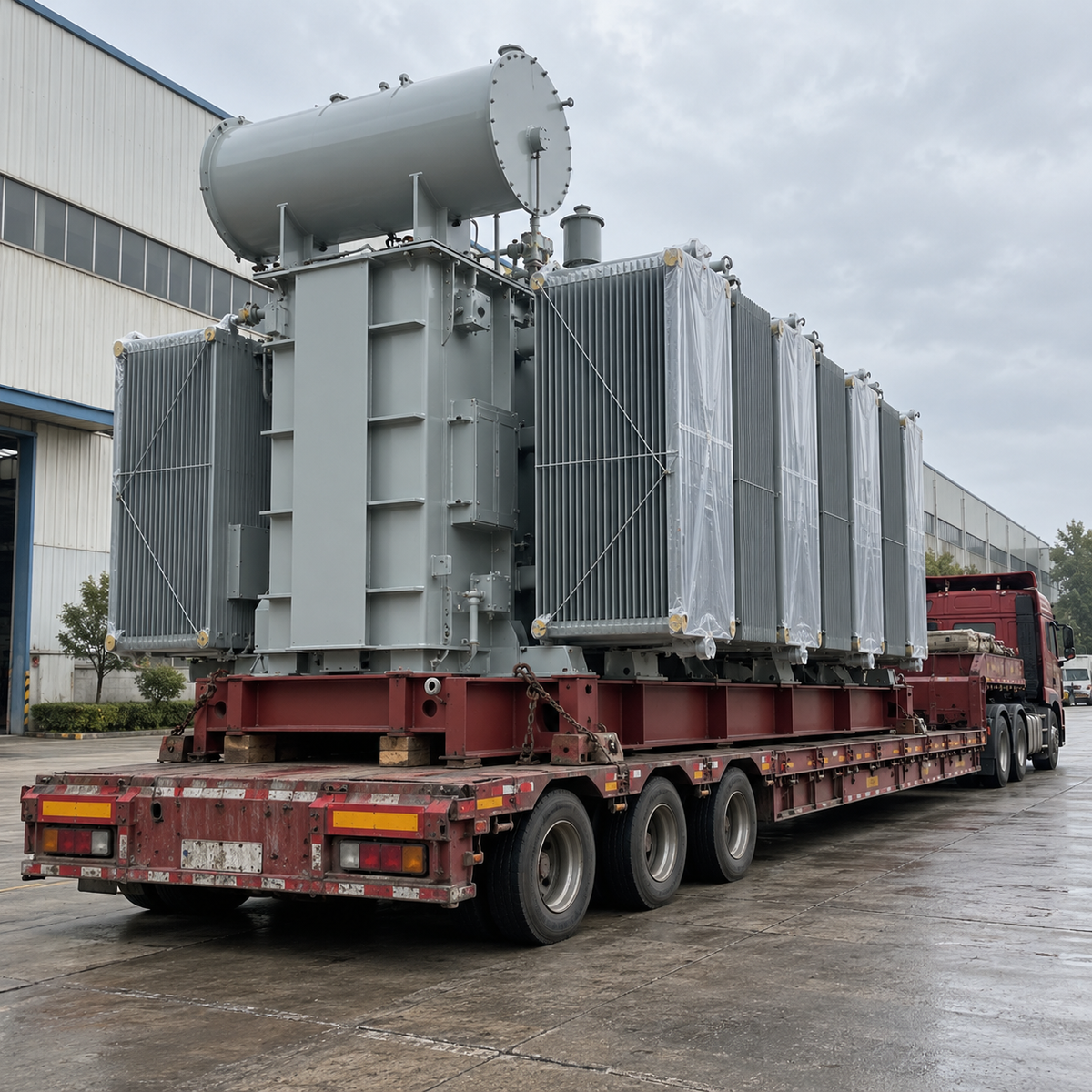
Substation transformer unloading requires an agreed physical-data package for the actual item that will arrive: shipping configuration, mass, dimensions, centre of gravity where required, and manufacturer-designated handling interfaces. The site lifting specialist must receive information matched to that configuration, not an unrelated catalogue weight or the final operating arrangement. Separately identify who prepares and approves the unloading plan, supplies resources and confirms site readiness.
AI-generated shipping illustration, not an actual HEAKOR delivery, approved transport arrangement or unloading plan.
This guide is for EPC procurement teams and industrial owners coordinating delivery of a liquid-immersed substation transformer, including projects in Vietnam. It is a document and supply-boundary checklist, not a lift plan. It provides no sling angles, crane capacities, jacking sequence or permission to move equipment. Qualified personnel must plan and execute the work using the approved equipment-specific instructions and site requirements.
Identify the state that will actually be handled
The handling data should describe the delivered assembly, including the components and liquid present at that stage. Request a shipping arrangement and an itemised packing list alongside the final general arrangement. Ask the supplier to distinguish the main transport item from separately packed equipment and to state which mass belongs to each configuration.
A liquid-filled transformer manufacturer's receiving and handling manual, Sections 2.1–2.5, describes different shipping arrangements and equipment-specific handling provisions. These examples establish why configuration matters; they are not instructions or standard supply features for HEAKOR equipment.
Record whether the quoted dimensions include packing and any protruding items. Ask whether a later drawing revision changes the transport envelope or supplied mass. If a figure is preliminary, label it as such and agree when confirmed information will be issued. Do not let an estimated tender figure silently become the basis for site execution.
Request a handling-interface drawing, not a photograph of a lug
The manufacturer must identify the intended handling points and the configurations to which its instructions apply. Ask for a controlled drawing or instruction identifying the relevant lifting, jacking, pulling or rolling provisions, where supplied. Do not infer that every visible loop or bracket can support the complete transformer.
A 2016 liquid-filled substation transformer design guide, page 16.0-7, distinguishes cover lifting loops from complete-unit lifting hooks. Its example is design-specific. The buyer's task is to request the equivalent distinction for the equipment being purchased, not copy another design's lifting arrangement.
Keep assembly identity explicit. A handling document for a tank without particular accessories should not be assumed to cover the same transformer after those accessories are installed. Ask the supplier to resolve any ambiguity before the lifting specialist completes the plan.
Create a pre-dispatch physical-data register
Each required field should have a source, status and responsible reviewer. Use the following suggested register to obtain consistent information. It is an original procurement checklist, not a statutory lift-plan template.
Review item: Item identity
Data or evidence requested: Transformer and shipment references; shipping drawing and packing-list revision.
Question to close: Which delivered assembly is being assessed?
Review item: Mass and configuration
Data or evidence requested: Confirmed mass with its configuration basis; separately packed items; preliminary/final status.
Question to close: Does the figure describe the actual item to be handled?
Review item: Envelope and access
Data or evidence requested: Shipping dimensions, protrusions and restrictions identified by the supplier; site route information.
Question to close: Have equipment and site constraints been reconciled?
Review item: Handling interfaces
Data or evidence requested: Approved point identification, applicable instructions, restrictions and any required centre-of-gravity information.
Question to close: Does the lifting specialist have the design-specific input?
Review item: Site readiness
Data or evidence requested: Named unloading location, access/readiness record and plan approval responsibilities.
Question to close: Who confirms the receiving location is ready?
Review item: Exceptions
Data or evidence requested: Open discrepancies, owner, due date and authorized disposition.
Question to close: What prevents release or requires a revised plan?
Ask the lifting specialist which additional information is needed for the selected method. Procurement should collect and track those requirements, rather than prescribe structural assumptions, support reactions or rigging details. If the supplier cannot provide a requested item, obtain an explicit response so the project can resolve the gap.
Separate equipment supply from unloading services
A transformer quotation should not leave the unloading boundary hidden in a general delivery statement. Identify who arranges the transport vehicle, unloading resources, qualified personnel, site access and the approved work plan. Name who issues the go/no-go decision if the delivered configuration or site conditions differ from the agreed basis.
An illustrative scope split might place transformer data with the equipment supplier and lift planning with a specialist appointed by the EPC. This is not a HEAKOR service commitment or a universal contractual arrangement. Record the actual allocation, including who pays for agreed changes and how schedule consequences are reviewed.
The existing split-shipment and site-reassembly guide addresses work packages needed to complete the transformer after delivery. This unloading register supports the earlier physical handling decision and does not replace that wider completion plan.
Reconcile changes before mobilization
A changed shipping arrangement needs a review of the affected unloading inputs. Require the supplier to flag changes to mass, envelope, installed accessories or handling interfaces. Obtain the receiving team's acknowledgement of the accepted revision before treating the data package as closed.
For example, if a proposal changes from separately packed equipment to an assembled shipment, ask which drawing and mass figures have changed and whether the existing plan remains applicable. Do not decide from appearance alone. Keep the question open until the responsible technical parties document their disposition.
Agree how arrival damage or an unexpected configuration will be reported and assessed. Physical receipt, unloading authorization and final equipment acceptance should be recorded as distinct decisions. None is permission to energize the transformer.
Frequently asked questions
Can operating weight be used as shipping weight?
Not without confirming the configuration basis. Request the mass for the actual transport item and identify separately packed equipment or liquid where applicable.
Can the site team use a similar transformer's handling drawing?
Only the responsible design authority can establish applicability. Request instructions and drawing identity for the supplied equipment rather than accepting visual similarity.
Must every order include jacking or rolling provisions?
Do not assume inclusion. State the intended handling requirement and ask the supplier to confirm the offered interfaces and their limitations.
Does this checklist establish compliance with installation standards?
No. The project must identify its applicable requirements. For example, the official IEEE C57.93-2019 scope covers liquid-immersed power transformers rated 501 kVA and above with secondary voltages of 1,000 V and above, excluding special transformer types identified in its scope. Its listing is not equipment approval or a universal destination requirement; confirm the applicable edition and amendments with the project engineer.
Include the unloading data request in your HEAKOR enquiry
Use the oil-immersed substation transformer page and include the electrical duty, destination, intended transport arrangement, known site restrictions and required document dates. Identify the party responsible for the unloading plan and the data it needs.
Submit Your Project Specification to request a proposal identifying the equipment configuration, document availability and service boundaries. Drawings, handling provisions and site services require confirmation for the actual offer. Blank checklists in the document centre help organise the enquiry; they are not approved handling drawings or equipment datasheets.