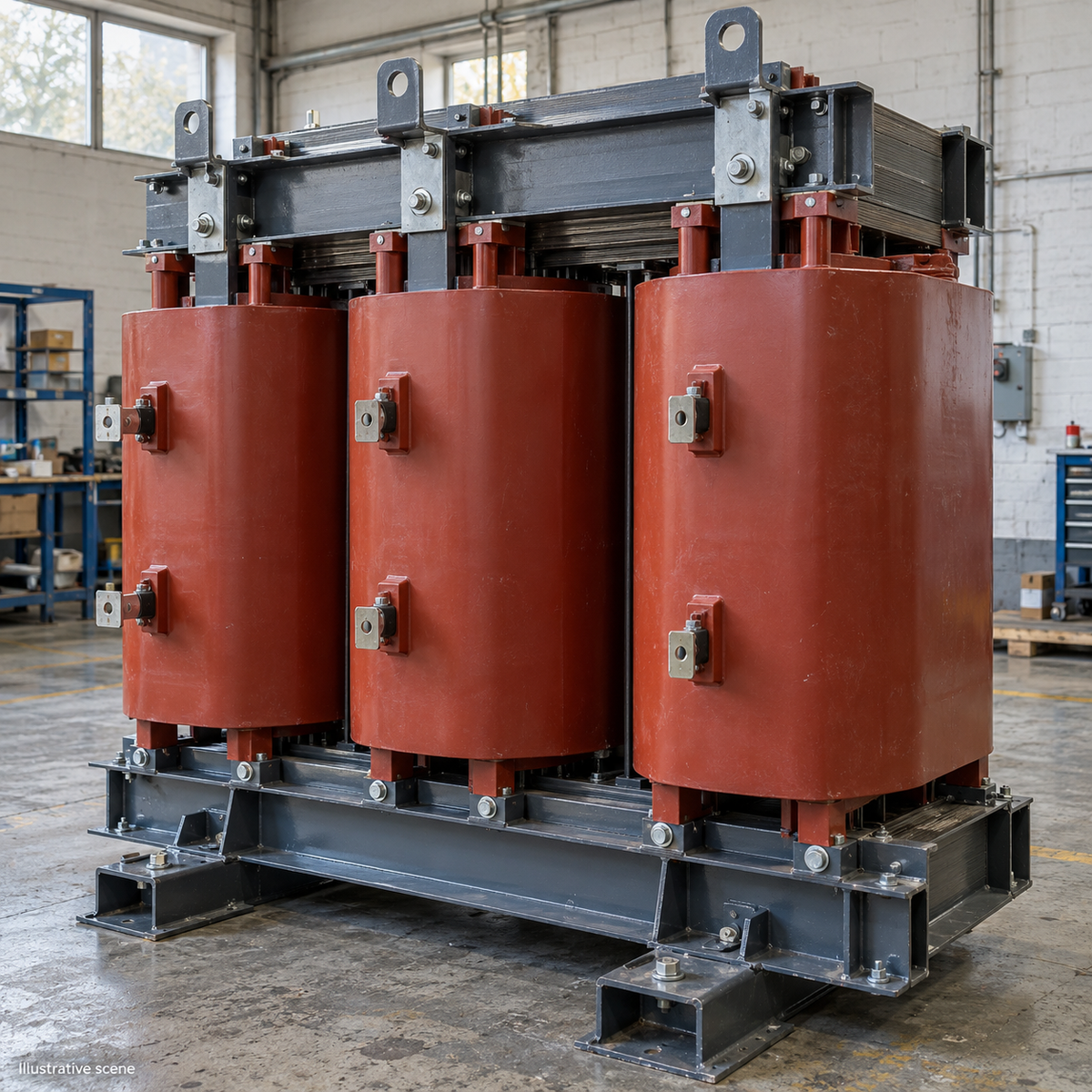
Dry-type transformer classes for climate, environment and fire behaviour address separate requirements. Record the required C, E and F codes individually, identify the applicable IEC 60076-11 edition, and check each supporting report against the offered design. Class codes in a quotation do not establish their own evidence scope. For EPC, consultant and procurement teams, the acceptance question is whether the documented classification supports the proposed transformer under the project's stated conditions.

What do dry-type transformer classes C, E and F mean?
The letters identify separate areas of performance. They should remain separate rows in your technical comparison:
- Climatic class, C: addresses climatic conditions, including low-temperature suitability. Record operating conditions separately from transport and storage conditions.
- Environmental class, E: addresses environmental exposure such as condensation and pollution. Identify the actual installation and enclosure arrangement before selecting a requirement.
- Fire-behaviour class, F: addresses behaviour under specified fire-test conditions. It does not establish that a transformer is fireproof or settle the building's fire-protection design.
These are different from the insulation system's thermal class and the enclosure's IP designation. For example, a thermal-class entry marked F is not evidence of fire-behaviour class F1. Do not combine the two fields under a vague heading such as “safety class.”
Which standard edition should the quotation identify?
Use the edition required by the project and resolve any mismatch before technical acceptance. The IEC listing for IEC 60076-11:2018 identifies dry-type transformer scope, revisions to climatic classes and environmental-class relationships, and included corrections. An undated “IEC 60076-11” statement leaves important context missing.
The standard's published scope covers dry-type power transformers with highest voltage for equipment up to and including 72.5 kV and at least one winding operating above 1.1 kV, with specified exclusions. That scope is not a HEAKOR product rating or a promise that every dry-type transformer falls within it.
Ask the supplier to show the edition used for the offered design and for each supporting report. If an older report is submitted, request a written review of its relevance to the specified edition. Avoid treating a new document cover or recent quotation date as evidence that the underlying test was updated.
How should you check the class evidence?
Start with the complete supporting document, then connect it to the offer. A cropped certificate image or a brochure badge is an incomplete basis for acceptance.
- Identify the record. Request the issuer, report or certificate number, date, standard edition, tested class and result. Distinguish a test report from a certification document and a manufacturer's declaration.
- Identify the tested object. Record its model or design reference, rated power, voltage information, insulation construction and relevant enclosure or accessory arrangement. Use the document's own description.
- Identify the offered transformer. Match the quotation, technical schedule and drawing revision. Ask the supplier to explain differences rather than leaving the buyer to infer equivalence.
- Document applicability. When the offered unit differs from the tested object, request the technical basis and applicable standard provisions supporting use of that evidence. A family name alone is insufficient.
- Close open points. Record accepted evidence, qualifications, unresolved differences and the person responsible for approval. Keep that record with the purchase specification.
This review does not mean every ordered rating necessarily needs an identical repeat test. It means the relationship between the tested design and the supplied configuration must be established. Avoid both extremes: assuming one report covers the whole catalogue, or rejecting relevant evidence solely because the tested rating differs.
Describe exposure before choosing a class
The engineering team should define the site's conditions before procurement copies class codes into an RFQ. A useful site note covers minimum operating temperature, transport and storage exposure, condensation, pollution, indoor or outdoor location, and enclosure arrangement. Mark unknown conditions for review.
Include the period before commissioning. A transformer may arrive while the building is incomplete or remain de-energised in storage. Ask which delivery, storage and installation precautions apply to the proposed equipment, and who is responsible for maintaining those conditions.
Keep other design questions visible. Ambient temperature, altitude, cooling, room ventilation and enclosure protection need their own review. A climatic or environmental class entry should not silently replace these project inputs. Likewise, agree the applicable fire and installation requirements with the responsible project engineer.
For delivery-stage documentation, use the separate dry-type receiving and storage handover guide.
Build an acceptance record the purchasing team can use
Use one line for each requested class, with fields for the requirement, offered class, evidence reference, applicability explanation, deviation and acceptance status. Ask for a clear response such as confirmed, qualified or awaiting evidence, rather than a single “compliant” statement covering the entire order.
Agree when supporting documents are due. If class evidence is needed for design approval, make that review an explicit step before releasing the relevant purchasing or manufacturing decision. Keep routine test records and class evidence as distinct deliverables: the standard treats climatic, environmental and fire-behaviour tests separately from routine tests.
Use separate fields for class evidence
| Field | What to record | Evidence question |
|---|---|---|
| Climatic class C | Required code, operating and storage conditions | Does the report support the offered design and stated exposure? |
| Environmental class E | Required code, condensation and pollution conditions | What installation and enclosure arrangement does the evidence cover? |
| Fire-behaviour class F | Required code and applicable project requirement | Which tested object and applicability basis support the claim? |
| Thermal class and IP | Separate insulation and enclosure entries | Are these recorded independently from C, E and F? |
For the unit identity and document revision checks, use the transformer test-report traceability guide. A report reference should lead to an identifiable record and an explicit applicability decision.
For the wider evidence request, review the project technical documents and identify the records required before approval.
Frequently asked questions
Can I copy C2, E2 and F1 from another project's specification?
Use another specification only as a starting point. The responsible engineer should confirm each required class against this site's conditions and the applicable edition, then request matching evidence.
Does an IP-rated enclosure establish an environmental class?
No. Record enclosure protection and environmental classification separately. Ask how the offered enclosure and installation arrangement relate to the class evidence submitted.
Is a laboratory logo enough to accept a class claim?
No. Request the identifiable report or certificate, its scope and its connection to the offered design. Confirm unclear or inconsistent details with the supplier and, where necessary, the issuing body.
Should a design change trigger another evidence review?
Yes. Ask the supplier to assess changes affecting the basis of the class claim and update its applicability statement. The responsible reviewer should decide whether existing evidence remains sufficient or additional verification is needed.
Can a class report replace project approval?
No. A class report supports a defined technical claim. The buyer still needs acceptance against the project's complete specification, documentation requirements and applicable installation obligations.
Request a dry-type transformer compliance review
Explore HEAKOR dry-type transformers and submit your project specification for a configuration and documentation review. Include phase, kVA, primary and secondary voltages, frequency, destination, site conditions, required class codes, standard edition and approval-document requirements. Ask the response to identify the proposed configuration, available supporting evidence and any items requiring further confirmation.