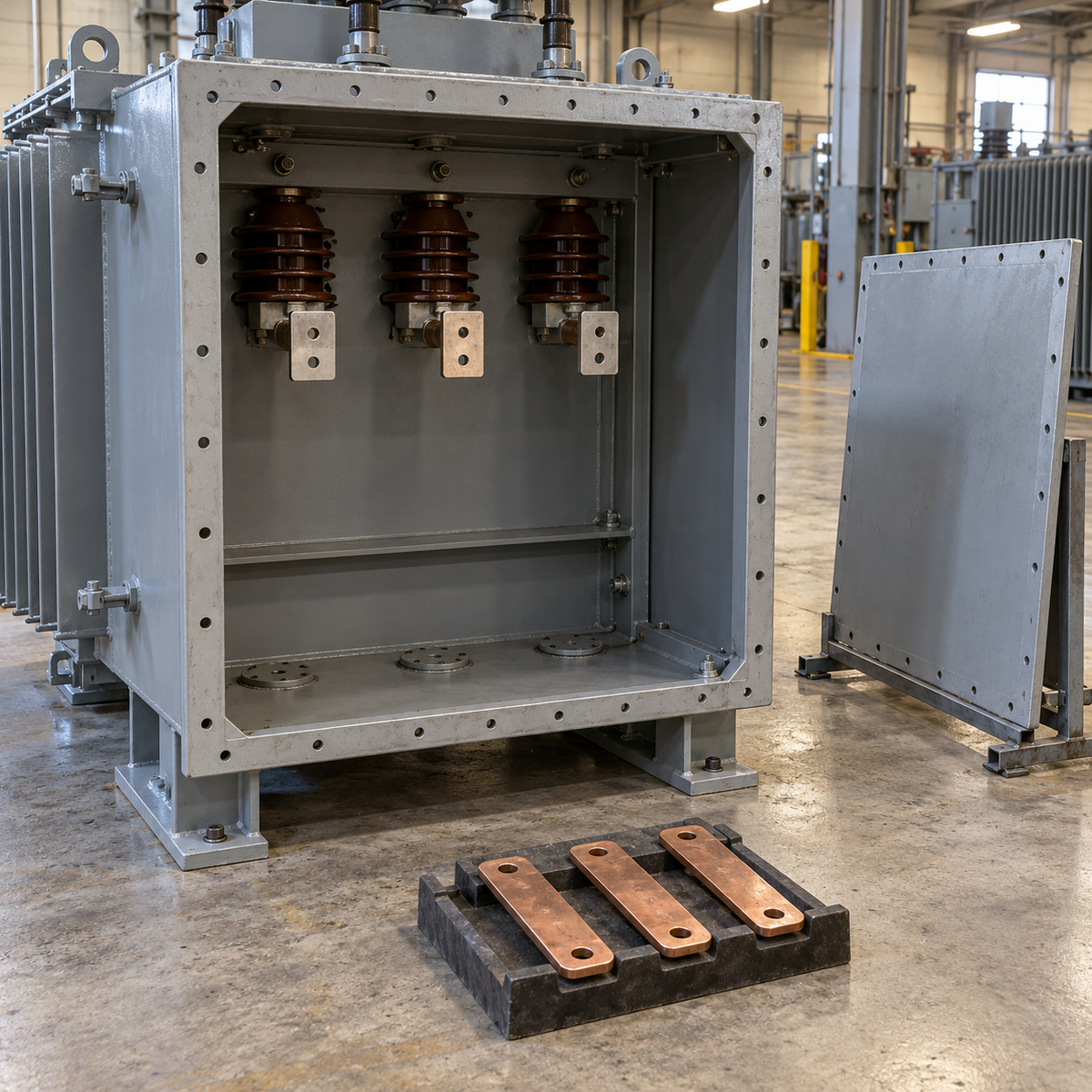
AI-generated cable-box illustration; not a HEAKOR product, verified circuit, approved separation arrangement or cable-testing procedure. Loose bars do not establish compatibility with the illustrated terminals.
Transformer cable-box disconnecting links should be purchased against a defined separation requirement: which cable circuit must be tested separately from which transformer winding, and what arrangement makes that separation possible? Ask for the proposed connection drawing, the equipment included on each side of the separation boundary, and the access and responsibility details. A quotation saying “cable box included” does not establish those features. Agree the required arrangement before accepting the offer, not when the commissioning contractor arrives.
This guide is for EPC procurement teams buying three-phase oil-immersed substation transformers for industrial projects in Kenya. It concerns air-insulated cable-box purchase scope where separate cable testing is required. It is not a disconnection, testing or restoration procedure. Qualified personnel must work under the equipment instructions and the owner’s approved safety and commissioning arrangements.
Ask for a separate-testing arrangement, not merely a removable cover
A cover provides access; the proposed electrical arrangement must separately establish the required test boundary. Ask the transformer designer to identify the relevant winding terminals, cable terminations and disconnecting links or chamber, where offered. The buyer’s engineer should confirm whether that arrangement supports the intended cable-test scope.
The September 2025 Kenya Pipeline Company transformer tender, section 7.6, separately specifies cable-box construction and disconnecting links. This is a purchaser-specific example, not a national rule or evidence that every cable box has the same features. Its terminal assignments must be read with the relevant equipment data sheets; do not infer the connected winding from the box’s description alone.
Keep three decisions distinct: the required transformer dielectric tests, the cable-system tests, and the hardware boundary needed between them. The transformer dielectric-test coverage guide addresses the first decision. It does not approve the cable-box arrangement or prescribe cable testing.
Define what remains on each side of the boundary
The drawing should identify the equipment covered by the intended separation, rather than leaving “disconnectable” undefined. Ask for terminal and component identifiers that can be reconciled with the transformer and cable schedules. Where other connected equipment is proposed, require the designer to identify its relationship to the boundary.
Prepare a short requirement statement for the technical reviewer: “The project requires separate testing of the identified cable circuit; please confirm the offered arrangement and its limitations.” Let the engineer and performing organization define the test method, voltage, isolation provisions and acceptance criteria. Procurement should not turn a catalogue illustration into those instructions.
Two offers can therefore require different dispositions. One may include an identified separation arrangement with supporting drawings; another may include only a termination enclosure and leave the testing interface unresolved. The second offer is not automatically defective, but it is not yet comparable for the stated requirement.
Close the purchase questions in one boundary record
Use the following original procurement record to distinguish an included feature from an assumption. It is not a standards-mandated form or an engineering approval.
| Purchase question | Evidence to request | Decision owner |
|---|---|---|
| Which circuit requires separate testing? | Cable-circuit and transformer-winding identifiers, with the approved requirement reference. | Owner’s electrical engineer |
| Where is the proposed separation? | Connection drawing identifying the relevant terminals, links or chamber and equipment on either side. | Transformer designer, reviewed by the project engineer |
| Does the installed layout preserve access? | Box and cover details coordinated with the cable approach and adjacent equipment. | Equipment and site-layout reviewers |
| What is actually purchased? | Itemized hardware, documentation and service scope, with each exclusion assigned to a named package. | Procurement and package owners |
| What closes an open item? | Accepted drawing revision or explicit deviation disposition, linked to the purchase release. | Authorized technical reviewer |
Do not accept “by others” as a closed responsibility. Name the receiving package and confirm that its owner has accepted the item. Request a revised response if a later cable or box change affects the agreed boundary.
Keep transformer removal separate from cable-test separation
Separate cable testing and removing the transformer without disturbing cable terminations are different requirements. Neither should be inferred from the other. If the owner needs both, list both and ask for evidence for each.
For a removal requirement, obtain a separate proposal identifying the retained assembly, support responsibility and affected interfaces. Do not extend approval of the test-separation drawing into approval of lifting, cable support or a replacement method.
Frequently asked questions
Does a disconnecting link mean the box can interrupt load current?
Do not assume it does. The offer must identify the device and its intended function; a disconnecting-link description is not a declaration of load-switching capability. This procurement guide authorizes no operation.
Can the cable-termination kit be selected after the box is ordered?
Only with explicit control of the unresolved interface. Have the responsible suppliers identify the assumed termination arrangement and the information required before the box design is released. A later kit selection needs review against those assumptions.
Does the transformer supplier automatically provide the cable-testing service?
No service should be inferred from included hardware. State separately who supplies the equipment, who prepares and performs the approved tests, and who provides the required records.
Can this checklist be used unchanged for a separable connector system?
No. A different connection system requires a design-specific assessment of its interfaces and permitted functions. Keep this review within the agreed air-insulated cable-box scope.
Send HEAKOR the required boundary, not just a box description
Start with HEAKOR’s substation transformer enquiry category. Include the Kenya project destination, transformer rating, complete winding voltages, phase and frequency, governing specification, cable-connected winding and available cable schedule. Attach the separate-testing requirement and identify any independent transformer-removal requirement.
Submit Your Project Specification and request a response identifying the proposed cable-box arrangement, documents, exclusions and unresolved interfaces. Use the technical document centre to frame the requested drawing package. Configuration availability, suitability, documentation and any site service require written confirmation for the actual HEAKOR offer; this guide is not proof of Kenyan project approval.