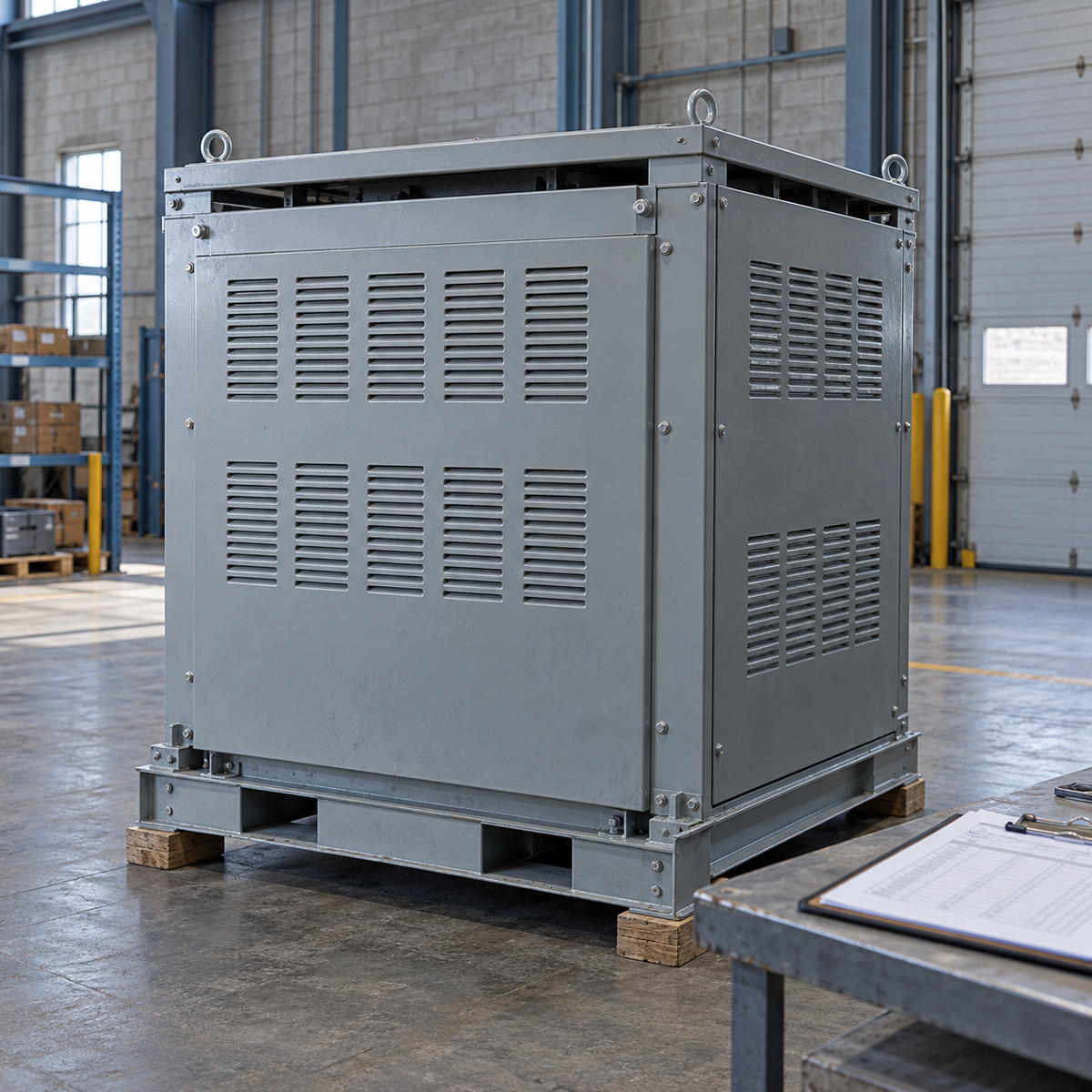
Specify dry-type transformer primary taps with a position-by-position schedule of primary voltage, secondary-voltage basis and permitted kVA under the agreed conditions. A percentage range alone leaves important procurement questions unanswered. If full capacity is required at every offered position, ask the supplier to state that commitment explicitly for the proposed design. This guide concerns U.S. industrial purchases of low-voltage dry-type transformers at a specified 60 Hz duty. It does not cover tap-changing procedures, on-load regulation or changing the operating frequency.
AI-generated illustration for primary-tap rating document review; not a HEAKOR product photograph, connection drawing or tap-adjustment instruction.
What does a full-capacity tap mean?
A full-capacity tap allows the transformer to provide its rated kVA without exceeding its specified temperature rise. FCAN and FCBN refer to full-capacity taps above and below nominal, respectively. The definition concerns operation at the corresponding primary input voltage; it is not a blanket assurance for any supply condition. See the technical definition of a full-capacity tap.
For a buyer, the next step is to connect that wording to the actual offer. Ask which tap positions are included, which positions carry the capacity commitment, and what rating and operating conditions the statement references. Do not expand a general definition into an undocumented feature of a particular transformer.
Start with the operating requirement
Give bidders the required primary supply range and the required secondary duty, rather than asking only for a familiar tap percentage. State rated kVA, phase, 60 Hz operation, installation conditions and any specified temperature-rise requirement. Identify whether the supply information is a project design requirement, a utility value or a site observation so the engineer can review its relevance.
Keep the required duty separate from possible future uses. If a future supply change is only a planning assumption, label it that way. Otherwise, bidders may price different interpretations while appearing to answer the same request. The approved purchase schedule should show which operating cases are mandatory and which remain subject to a later review.
Dry-type transformer primary taps: the rating schedule
The following schedule is an original procurement aid. It does not prescribe a standard tap range, connection arrangement or mandatory test. Ask the supplier to complete it for the proposed model and identify any value that remains provisional.
| Schedule item | Supplier entry | Buyer decision |
|---|---|---|
| Position identification | Identifier matching the offered connection drawing | Can every row be traced to one actual position? |
| Primary voltage | Rated input voltage for that position | Does the position address a required supply case? |
| Secondary basis | Declared output voltage and the conditions used | Is the intended secondary duty addressed consistently? |
| Permitted capacity | kVA for that position, with any limitations | Is the required load supported on the stated basis? |
| Current information | Relevant winding current limits or referenced rating record | Does the technical review have enough rating evidence? |
| Operating conditions | Frequency, thermal and site basis | Are all bidders answering the same requirement? |
| Design reference | Proposed model, nameplate and drawing revision | Will the accepted schedule follow the ordered design? |
Compare deviations before comparing prices
Treat a different tap arrangement as a technical deviation requiring a disposition. More positions, a wider range or familiar abbreviations do not automatically make one offer preferable. Compare the specific required operating cases against each bidder’s completed schedule.
| Bid response | Question to resolve | Procurement action |
|---|---|---|
| Tap percentages only | What voltage and capacity apply at each position? | Request the missing schedule. |
| Full capacity stated only at nominal | What applies to the other offered positions? | Obtain an explicit position-specific response. |
| Alternative tap range offered | Which project operating cases remain covered? | Request an engineering deviation review. |
| Capacity schedule conflicts with drawing | Which document controls the offered design? | Resolve and reissue the affected records before release. |
A clear exception is more useful than an optimistic assumption. Record whether the engineer accepts the alternative, needs more information or requires a revised offer. Keep cost and delivery comparisons on the same approved technical basis; a lower price cannot close an unresolved rating question.
Carry the accepted schedule into the order
Reference the approved tap schedule in the purchase documents and identify the drawing or rating record that supports it. Assign responsibility for resolving any later change. If a revised design changes position identifiers, tap voltages or the declared capacity basis, ask the supplier to show the change rather than replacing the original document without explanation.
At document handover, compare the ordered configuration with the final nameplate and connection information. The purpose is to preserve the purchasing commitment through delivery. Installation and any tap adjustment remain work for qualified personnel following the applicable equipment instructions and project safety procedures; this article supplies no connection sequence.
Keep neighboring technical decisions separate
A primary-tap schedule answers a defined voltage-and-rating question. It does not complete the assessment of frequency substitution, parallel operation or multiple secondary configurations. If the project needs any of those operating modes, identify the separate engineering review and evidence required instead of embedding the assumption inside the tap description.
Frequently asked questions
Can a percentage description replace voltage entries?
Use actual voltage entries for the approved schedule, even if the enquiry starts with percentages. This makes the nominal reference and each required operating case explicit for comparison.
Should a replacement order copy the old tap labels?
Provide the existing records as reference and state the present operating requirement. Ask the supplier and project engineer to confirm the replacement schedule rather than assuming the old labels establish the new design’s ratings.
What if the required primary range is not yet confirmed?
Mark it as provisional and identify who will confirm it. Do not close the rating review using a nominal value that the project team has not accepted as its design basis.
Does a complete tap schedule establish overall U.S. approval?
No. Keep applicable product, efficiency, listing and project requirements in the wider compliance review. A completed voltage-and-capacity schedule addresses only its defined part of the purchase.
Must every offered position be used?
The project may require only certain operating cases. Record which positions are required and which are merely available in the offered design; the engineer should decide how that affects acceptance.
Prepare a focused HEAKOR enquiry
For a dry-type transformer enquiry, start with HEAKOR’s dry-type transformer category and technical document checklist.
Submit Your Project Specification. Include destination; dry-type category; phase and 60 Hz; kVA; required primary operating range; secondary duty; thermal and site basis; required tap schedule and supporting design records.
Request a completed position-by-position rating schedule, supporting design references and explicit deviations for review. The proposed tap arrangement, ratings and supporting documents require confirmation; this guide does not establish their availability.